


Principal investigator: Prof. Martina Lotar Rihtarić, PhD

Principal investigator: Prof. Martina Lotar Rihtarić, PhD
Project team members:
Associates:
Previous research in this field has primarily focused on individual or social factors, or on specific aspects of the digital context that contribute to electronic violence. There is a lack of comprehensive studies examining the relative contributions of different factors. The socio-ecological model of cyberbullying (Patel & Quan-Haase, 2024) is a new theoretical framework that enables the planning and implementation of such comprehensive research, but it has not yet been systematically tested. This model highlights groups of different factors that affect cyberbullying among students and may also have certain interaction effects on its occurrence. The aim of this study is, within the framework of the socio-ecological model, to examine the contributions of individual and social factors, as well as characteristics of the digital context, in explaining the occurrence of cyberbullying, and to explore its effects on the mental health of primary and secondary school students. To achieve the project goals, a mixed-methods research approach is planned, involving three studies. In the first year, (1) a quantitative study will be conducted to develop and validate a scale for measuring perceptions of the digital context that fosters cyberbullying. In addition, (2) a qualitative study will explore how students perceive and describe the factors contributing to cyberbullying. In the second year, (3) a longitudinal study will begin, with three measurement points spaced one year apart, to determine how factors from the socio-ecological model explain cyberbullying and how it contributes to students’ mental health.
Project ENDIS makes a significant scientific and professional contribution to research on electronic violence among children and adolescents by systematically moving beyond previous fragmented studies, which have mainly focused on isolated groups of predictors. Grounded in the socio-ecological model, the project offers a comprehensive understanding of the complex relationships among individual and social factors and the characteristics of the digital context, considering their interactions and developmental dynamics.
The project's particular value lies in its methodological approach. By conducting several complementary studies – a pilot study, a qualitative study, and a longitudinal study – the project uses a mixed-methods design that enables a deeper understanding of electronic violence through the integration of quantitative and qualitative data. This approach enhances the validity and interpretive power of the findings and allows for the integration of statistical patterns with students’ experiences and perspectives.
The development and validation of a new scale to measure perceptions of the digital context is an important methodological contribution, given the lack of validated instruments that adequately capture the specific features of the digital environment relevant to electronic violence. Thus, the project goes beyond empirical testing of existing models and actively contributes to the development of research tools for future scientific and professional studies.
An additional methodological strength is the project’s longitudinal design, with three measurement waves conducted on a sample of primary and secondary school students which allows for the examination of the directionality and reciprocity of relationships between individual factors, electronic violence, and students’ mental health. This approach addresses key limitations of cross-sectional research and allows for the testing of developmental changes, as well as mediation and interaction effects within the socio-ecological framework. Given the scarcity of such studies in this field, the project represents a substantial methodological advancement.
In addition to its scientific contribution, the project has significant practical value, as it supports the development of evidence-based guidelines for professionals in education and mental health and informs the design of targeted preventive interventions at different levels of the socio-ecological system.
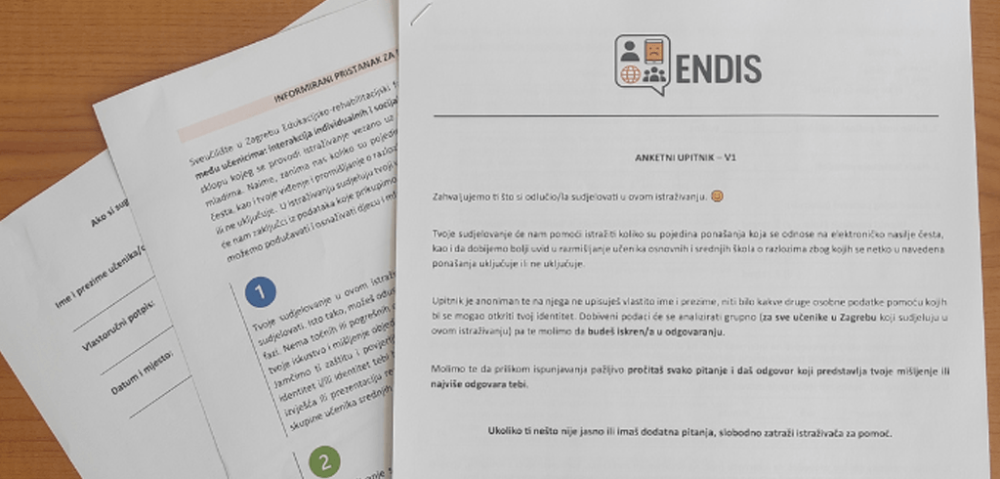
In March, two research components involving primary and secondary school students in the City of Zagreb were initiated as part of the scientific research project Cyberbullying Among Students: The Interaction of Individual and Social Factors and the Characteristics of the Digital Context (ENDIS): a quantitative pilot study and a qualitative study.
In the quantitative pilot study, students anonymously complete questionnaires measuring various constructs within the socio-ecological model that are important for understanding and explaining electronic violence among students.
Alongside the pilot study, a qualitative study is being conducted in which students participate in focus groups. This approach enables more detailed insights into students’ experiences, perceptions, and attitudes regarding electronic violence and the digital environment.
The collected data will contribute to a better understanding of the factors associated with electronic violence among students and represent an important step in the further preparation of the longitudinal study.