


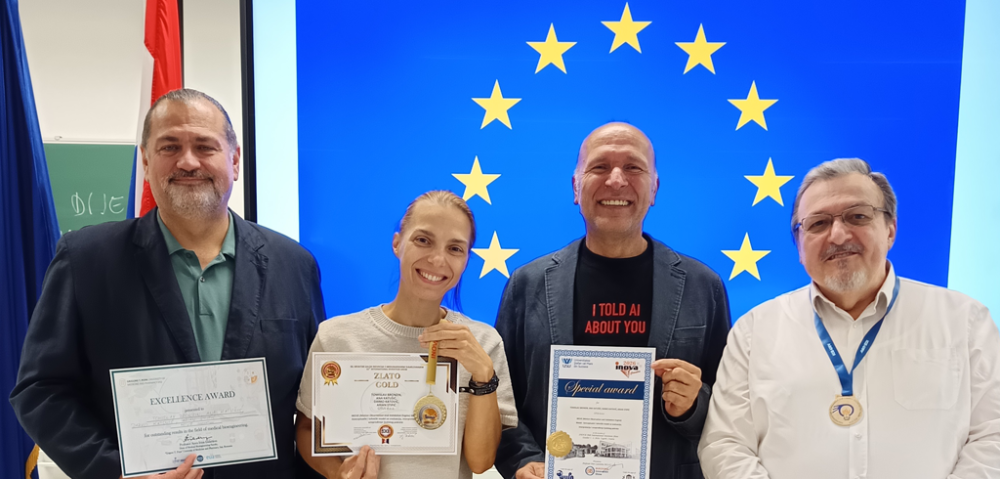
The MOVE (Motion Observation and Validation Engine) model, developed within a project led by the University of Zagreb Faculty of Education and Rehabilitation Sciences, won a gold medal at the 50th International Innovation Exhibition INOVA 2026. The exhibition took place in Zagreb from 1 to 3 October 2026, bringing together exhibitors from 23 countries and showcasing 509 exhibits.
The award-winning innovation is the result of interdisciplinary collaboration between the Faculty of Education and Rehabilitation Sciences, the University of Zagreb Faculty of Kinesiology, and CITUS within the project “Modelling and Analysis of Personalised and Optimal Movement Patterns in Rehabilitation, Sport and Fitness Using Artificial Intelligence (AI)”. The project is led by the Faculty of Education and Rehabilitation Sciences, with Assistant Professor Ana Katušić, PhD, serving as the project leader.
MOVE is a conceptual and technical model for evaluating, interpreting and improving human movement. It links objective movement measurement with the interpretation of performance quality, using anatomical reference points, relationships between body segments and defined indicators. A distinctive feature of the model is its set of rules for explaining deviations from reference movement patterns and suggesting activities to improve performance. This provides a foundation for developing personalised movement analysis systems, with potential applications in rehabilitation, sport, medicine and physical fitness assessment.
The MOVE model is one of the project’s first key outcomes and provides an important methodological and technological foundation for further research and scientific validation. The gold medal highlights the Faculty of Education and Rehabilitation Sciences’ contribution to technological innovation and the value of combining education and rehabilitation sciences, kinesiology and information technology to develop solutions that address human needs.
The project is co-funded through the support programme for collaborative scientific research.
The views and opinions expressed are those of the author only and do not necessarily reflect those of the European Union or the European Commission. Neither the European Union nor the European Commission can be held responsible for them.