


Principal investigator: Assoc. Prof. Dora Dodig Hundrić, PhD

Principal investigator: Assoc. Prof. Dora Dodig Hundrić, PhD
Project team members:
Associates:
Previous research in the field of gambling has contributed to understanding the etiology and phenomenology of gambling addiction, as well as potential interventions for individuals with gambling disorders. However, most studies have focused primarily on gamblers themselves. Significant others - partners, parents, children, and friends - have been largely overlooked in research, despite scientific evidence indicating a range of harmful psychosocial consequences they experience. Gambling-related harm is often hidden and difficult to quantify, and a major limitation of existing instruments lies in their insufficient differentiation by relationship type, which consequently limits their applicability in clinical practice. The aim of this project is to contribute to a more comprehensive scientific understanding of gambling-related harm among significant others, and to develop and validate specific self-assessment instruments - separately for parents and partners of individuals with gambling problems. Using a mixed-methods approach, the research will be conducted in four phases: (1) literature review and analysis of findings from a pilot project (quantitative methodology), (2) qualitative research (focus groups with significant others; N=24 participants), (3) construction and validation of self-assessment instruments (N≈200 participants), and (4) quantitative research on a national sample (N≈200) aimed at identifying gambling-related harms experienced by significant others as well as other relevant correlates. The key scientific contribution of this project lies in the development and validation of new self-assessment instruments for measuring gambling-related harm among significant others, specifically adapted to relationship type (parents or partners of individuals with gambling problems). This approach overcomes the limitations of currently available international instruments. Furthermore, the project has evidence-based practical implications, including the creation of guidelines for the application of these instruments in practice and the development of psychosocial interventions targeting significant others of individuals with gambling addiction.
The proposed project represents an innovative contribution to gambling addiction research because it shifts the focus from problem gamblers to their significant others, thereby addressing an important and under-researched phenomenon. By using a mixed-methods approach, the project will facilitate an understanding of the complexity of significant others’ experiences, while the development of differentiated self-report instruments (depending on relationship type) will further ensure the relevance and applicability of the results. In this way, the project establishes a link between science and practice, as the findings will serve as a foundation for developing evidence-based guidelines for assessment and the design of interventions aimed at supporting significant others affected by gambling problems at the national level, across different types of treatment and care.
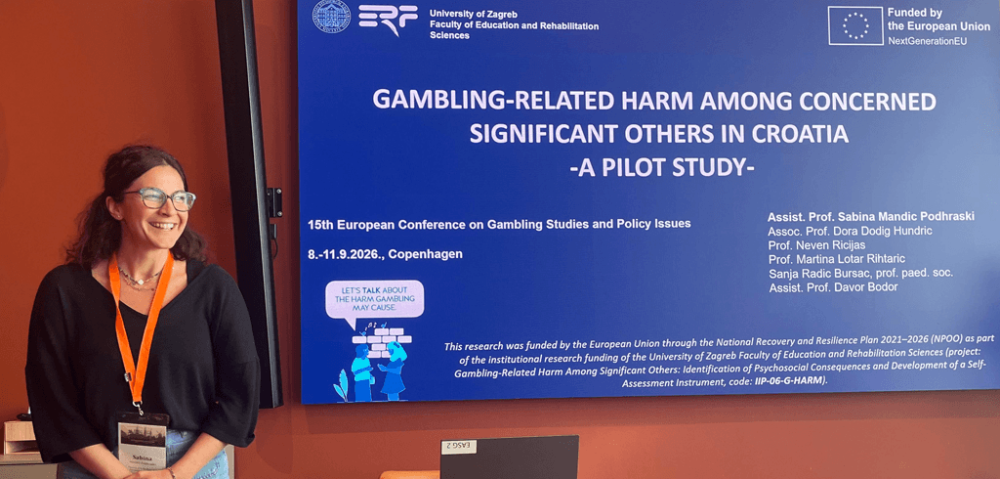
Members of the research team of the project “Gambling-Related Harm Among Significant Others: Identification of Psychosocial Consequences and Development of a Self-Assessment Instrument” (IIP_06-G-HARM) participated in the international conference EASG 2026 – 15th European Conference on Gambling Studies and Policy Issues: From Breaking Barriers to Building Bridges, held in Copenhagen, Denmark, from 8 to 11 September 2026.
The EASG Conference is one of the key international meeting points for researchers, practitioners, policymakers, gambling operators and other stakeholders in the field of gambling. In addition to presenting current research and professional insights, the conference provides an important opportunity for the exchange of knowledge and experience and for discussion of contemporary challenges related to the prevention and treatment of gambling-related problems, harm reduction, and responsible gambling.
The results of the pilot study conducted within the project were presented at the conference in a presentation entitled “Gambling-Related Harm Among Concerned Significant Others in Croatia – A Pilot Study”.
The conference was attended by Assoc. Prof. Dora Dodig Hundrić, the project leader, and project team members Prof. Neven Ricijaš, PhD, and Assis. Prof. Sabina Mandić Podhraški who delivered the presentation.
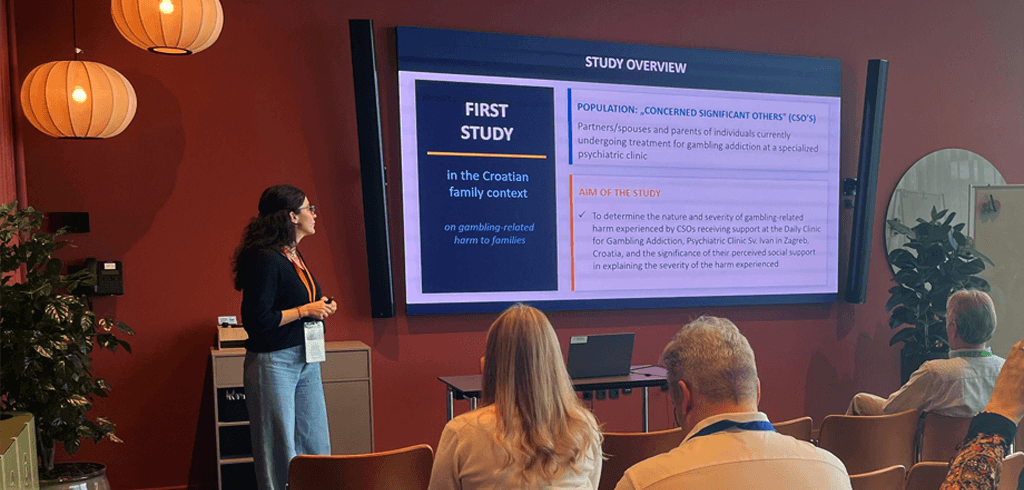
Participation in the conference also provided an opportunity to present the project’s work to date to the international scientific and professional community and to exchange experiences relevant to its further implementation. The project will continue with the qualitative phase of the research, which will include focus groups with partners and parents of individuals experiencing gambling-related problems.